Structural Drying in Leander, TX
A room that feels dry can still hold water in the framing, the wall bottoms and the slab. The drying team dries to a measured goal and leaves only when the readings say so.
(888) 926-4485Get Leander water extraction started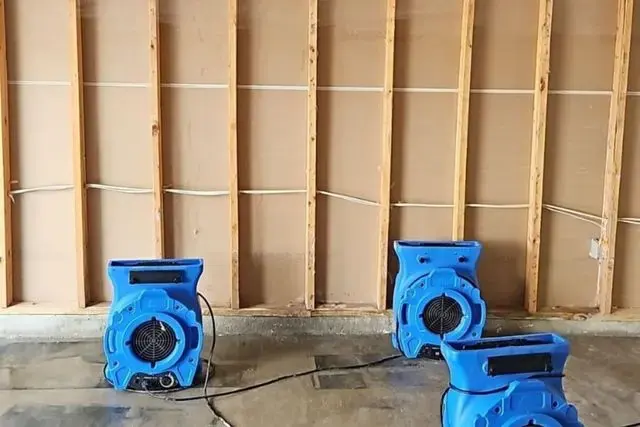
What to do the moment you find structural drying
Keep the house closed
Shut windows and doors so the dehumidifiers work on inside air.
Set the thermostat
Keep the AC at a normal comfortable setting, not off.
Leave equipment running
Do not unplug or move air movers or dehumidifiers.
Note new stains
Tell the drying team about any spot that looks worse, not better.
How structural drying is handled in Leander
Moisture mapped first
The tech who does the walkthrough maps the wet area with pinless meters and thermal imaging before any equipment goes down, so the plan matches what is actually wet.
Equipment sized to the room
The drying team sets air movers to each room's evaporation load and runs LGR dehumidifiers, and the gear stays until the readings say dry.
Claim-ready documentation
Daily moisture readings, psychrometric logs and timestamped photos go into the job file, the record an adjuster reads.
What does structural drying cost in Leander, TX?
In Leander, TX, structural drying typically runs $1,000 to $5,000 for most residential losses, priced mostly by equipment days. The class of the loss, the square footage and the materials involved drive the cost.
Class 1 or 2, one area
- Air movers and LGR unit
- Daily readings
- Three to four days
Class 3, several rooms
- More equipment
- Wall and ceiling drying
- Psychrometric logs
Class 4, dense materials
- Desiccant or heat drying
- Slab and hardwood focus
- Extended monitoring
Ranges move with the water category, the square footage, the material class and how fast drying started. For a closer planning number, try the water damage cost calculator.
Structural drying is the part of a water loss most people never see, and it decides whether the job holds up. Water that soaked into studs, bottom plates, drywall, cabinet bases and the slab does not leave just because the surface feels dry. The IICRC S500 standard sets how the trade dries a building, and the drying team works to it on every job.
Class 1 through 4 sets the equipment
The tech who does the walkthrough classifies the loss by how much water evaporation the room faces:
- Class 1: a small area with low-porosity materials.
- Class 2: a whole room, with carpet and wall wicking under two feet.
- Class 3: water from above, with walls, ceilings and carpet all wet.
- Class 4: bound water in dense materials like hardwood, plaster or concrete, which usually needs desiccant dehumidifiers or heat.
The class sets how many air movers and dehumidifiers the room needs.
Air movement, dehumidification, readings
Air movers pull water off wet surfaces into the air, and LGR (low grain refrigerant) dehumidifiers pull it back out of the air. The drying team takes psychrometric readings, temperature and humidity inside and out, each day to make sure the dehumidifiers are keeping up. Central Texas humidity can climb fast after a storm, so closing the house and letting the dehumidifiers work matters more than opening windows.
The drying goal
Before drying starts, the crew takes a reading on the same material in an unaffected room: the dry reference. Wet materials are dry when they read within roughly 2 to 4 points of that reference. A contained Class 1 or 2 loss usually gets there in three to five days; hardwood, slab and Class 4 losses take longer. Daily logs go into the file, which is what adjusters look for. The EPA moisture guidance and the Ready.gov flood recovery page both stress drying buildings quickly and fully.
Still damp days after a leak? Hidden moisture keeps working. Call (888) 926-4485
Covering Leander and the ZIPs around it
The Leander restoration crew covers the city and the paying ZIP areas around it, day and night.
Coverage runs across Leander (78641 and 78646), the Jonestown, Lago Vista and Point Venture side (78645), and on into Cedar Park and Liberty Hill.
Neighborhoods include Crystal Falls, Travisso, Palmera Ridge, Bryson, Benbrook Ranch, Mason Hills and Old Town Leander.
See every neighborhood and ZIPRelated water damage services in Leander
Structural Drying questions, answered
What is the IICRC S500?
It is the industry standard for professional water damage restoration. It covers how to classify water by category and class, how to set drying equipment and how to confirm a building is actually dry.
Why not just open the windows and run fans?
Box fans and open windows move air but do not remove moisture, and Central Texas outdoor air is often humid. Air movers paired with LGR dehumidifiers pull water out of the materials and out of the air.
How do crews know when a wall is dry?
They compare readings on the wet material to a dry reference reading on the same material in an unaffected room. When the wet area reads within a few points of that reference, it is dry.
Why is the equipment so loud and warm?
Air movers run at high speed to pull water off surfaces, and dehumidifiers give off heat as they work. That warmth actually helps drying, so the thermostat is usually set to a normal comfortable range.
Can I turn the equipment off at night?
It is best to leave it running. Drying works around the clock, and turning equipment off lets humidity rise and slows the job. Ask the drying team before moving or switching off any unit.
What are desiccant dehumidifiers for?
Desiccants pull moisture from air using a drying material instead of a cold coil. They work well on Class 4 losses with dense materials like hardwood and concrete, where refrigerant units slow down.
Water on the floor in Leander? Start the dry-out now.
Every hour of standing water pushes it further into drywall, baseboards and the slab. The Leander restoration crew extracts first, then dries to the IICRC S500 standard.
Leander, TX and southwest Williamson County